
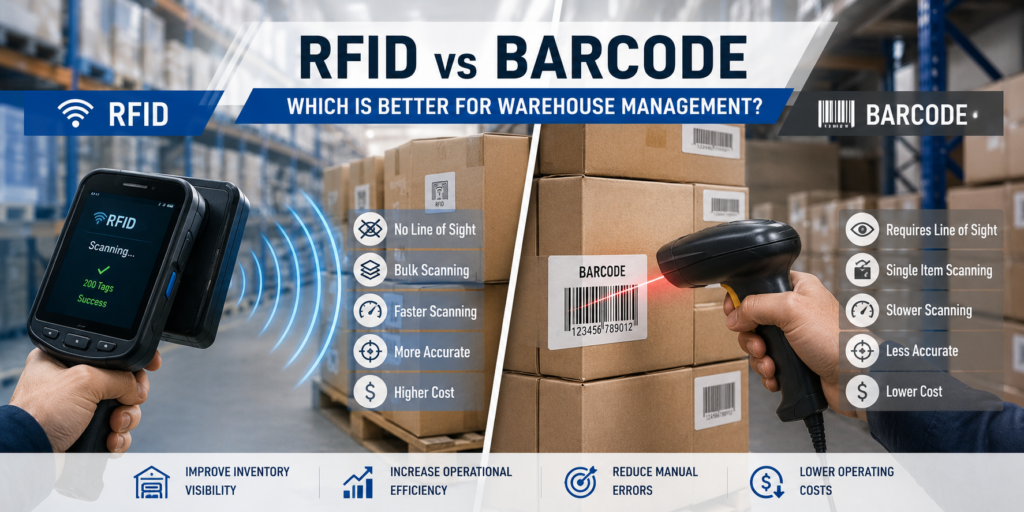
Efficient warehouse management is essential for improving inventory accuracy, operational efficiency, and supply chain performance. When comparing RFID vs Barcode systems, businesses must evaluate factors such as inventory visibility, automation, scanning speed, and warehouse scalability.
Modern warehouses are increasingly adopting RFID warehouse management solutions to improve inventory visibility, automate stock tracking, and reduce operational errors. While barcode systems are affordable and widely used ,RFID technology offers faster scanning, real-time tracking, and better automation capabilities.
Businesses using advanced inventory tracking systems can reduce manual errors, improve productivity, and optimize warehouse operations. Choosing between RFID and barcode depends on factors such as warehouse size, inventory volume, budget, and automation requirements.
In this guide, we compare RFID and barcode technologies based on speed, accuracy, cost, scalability, and warehouse performance.
RFID vs Barcode: What is RFID Technology?
RFID (Radio Frequency Identification) is a wireless technology that uses radio waves to track inventory, pallets, cartons, and assets in real time.
An RFID system usually includes:
- RFID tags
- RFID readers
- RFID antennas
- Inventory management software
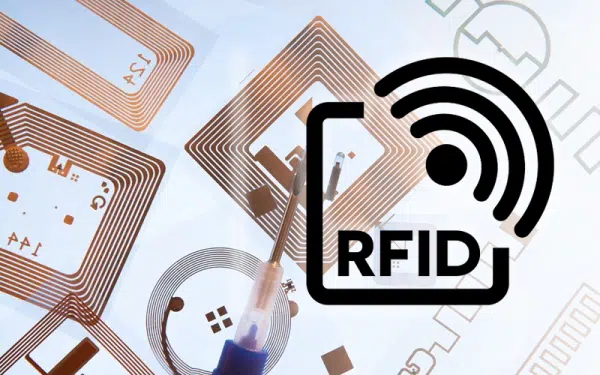
RFID allows businesses to scan multiple items simultaneously without direct line-of-sight scanning.
Learn more about RFID technology from GS1 RFID Standards.
Benefits of RFID
- Real-time inventory tracking
- Faster warehouse operations
- Reduced manual errors
- Better inventory visibility
- Improved asset tracking
RFID vs Barcode: What is Barcode Technology?
Barcode systems use printed labels that are scanned using barcode scanners. Each barcode stores product information in a visual code format.
Barcode systems are widely used because they are cost-effective and easy to implement.
Benefits of Barcode Systems
- Lower initial cost
- Simple implementation
- Easy product labeling
- Suitable for small warehouses

RFID vs Barcode: Key Differences
| Feature | RFID | Barcode |
|---|---|---|
| Scanning Method | Wireless | Optical Scanner |
| Line of Sight | Not Required | Required |
| Bulk Scanning | Yes | No |
| Speed | Fast | Medium |
| Accuracy | High | Moderate |
| Automation | Advanced | Limited |
| Cost | Higher | Lower |
RFID vs Barcode for Warehouse Management
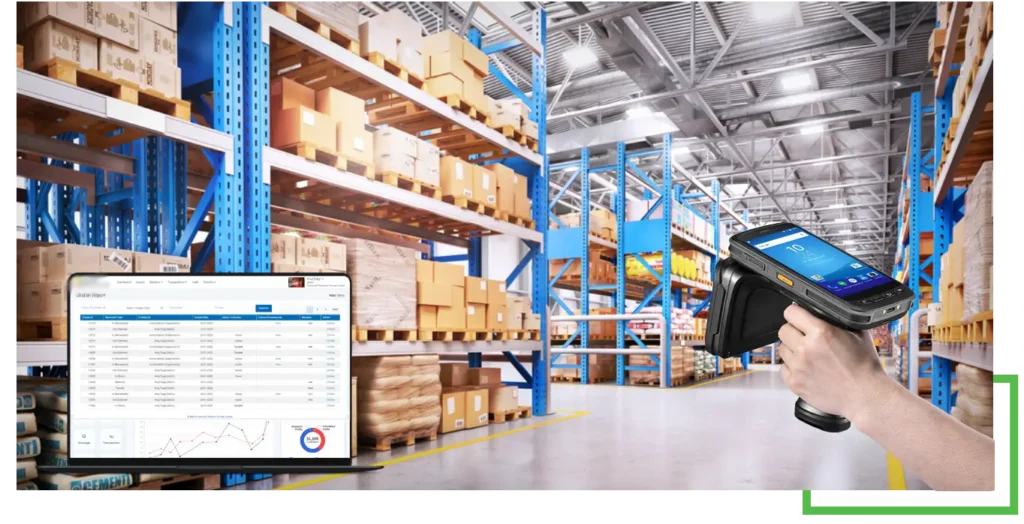
Large warehouses require speed, automation, and inventory accuracy. RFID warehouse management systems provide several operational advantages over barcode systems.
Faster Inventory Tracking
RFID can scan hundreds of products within seconds, reducing manual labor and improving operational efficiency.
Real-Time Inventory Visibility
RFID helps businesses monitor inventory movement in real time.
Improved Accuracy
RFID reduces human scanning errors and improves stock accuracy.
Better Warehouse Automation
RFID supports automated inventory management and smart warehouse operations.
According to IBM, RFID technology improves inventory visibility and operational efficiency.
When Barcode Systems are Better
Barcode systems are suitable for:
- Small warehouses
- Low inventory volume
- Budget-conscious businesses
- Basic inventory management
If a business does not require advanced automation, barcode systems can still be an effective solution.
RFID vs Barcode Cost Comparison for Warehouses
Barcode systems usually have lower upfront costs because barcode labels and scanners are inexpensive.
RFID systems require:
- RFID readers
- RFID tags
- RFID software integration
However, RFID provides better long-term ROI through:
- reduced labor cost
- faster operations
- improved inventory accuracy
- reduced inventory losses
Industries Using RFID Warehouse Management
RFID solutions are widely used in:
- Warehousing
- Logistics
- Manufacturing
- Retail
- Healthcare
- Supply chain management
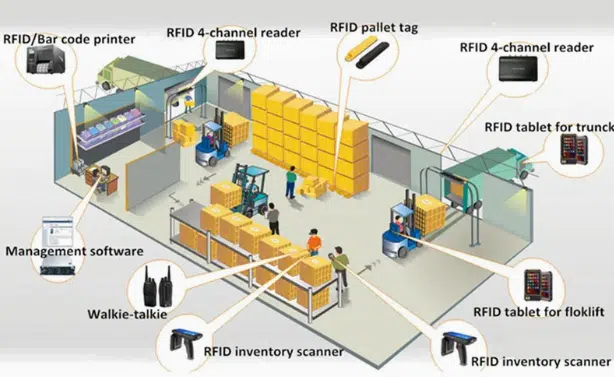
Businesses handling large inventory volumes benefit the most from RFID tracking systems.
Future of Warehouse Automation
Modern warehouses are moving toward automation, real-time tracking, and smart inventory management. RFID technology plays a major role in digital warehouse transformation.
As businesses focus on operational efficiency, RFID adoption continues to grow globally.
Conclusion
Choosing between RFID vs barcode depends on warehouse size, inventory volume, and automation requirements.
Barcode systems are ideal for basic inventory tracking, while RFID warehouse management systems are better for businesses seeking speed, scalability, and real-time inventory visibility.
Companies investing in warehouse automation can achieve higher operational efficiency with RFID technology.
Looking for advanced RFID warehouse management solutions?
Explore:
Sure Solutions RFID Solutions
Contact:
Sure Solutions
FAQ
RFID uses radio waves for wireless inventory tracking, while barcode systems require optical scanning and direct line-of-sight.
Yes, RFID is better for large warehouses because it offers faster scanning, automation, and real-time inventory tracking.
In many advanced warehouses, RFID is gradually replacing barcode systems due to higher efficiency and accuracy.
Barcode systems are cheaper initially, but RFID provides better long-term operational benefits.